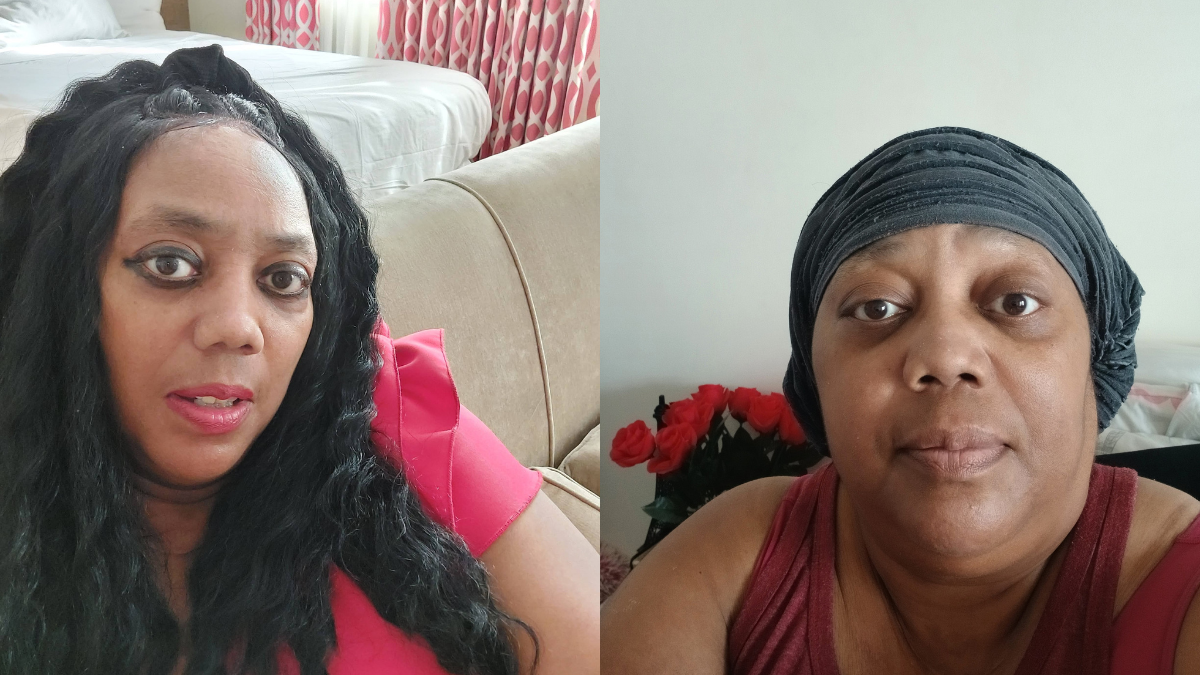
That night in October 2023, she and her mother headed to the emergency room. Hours later, doctors told her she had breast cancer.
“It felt like everything hit at once,” she says. “My health, my job, my money, my family. All of it.”
Navigating treatment and its side effects
Through additional tests and visits, Dorthea learned she had stage IIa HER2-positive breast cancer. An MRI found additional areas of concern in her left breast, and surgery later confirmed cancer cells in the milk duct. After considering a lumpectomy, she ultimately chose a single mastectomy of her left breast, the option that felt safest for her long-term health.
Following surgery, Dorthea began chemotherapy and targeted therapy, including trastuzumab (Herceptin), a medicine used for HER2-positive breast cancer. Her body reacted strongly. She experienced allergic reactions, fluid around her heart, and signs of heart weakness. Dorthea had never faced these conditions before.
“I started calling myself ‘Miss Side Effects,’” she says. “If a medicine has a side effect, I’m going to have it.”
Working closely with her oncologist, she made the difficult decision to stop HER2-targeted therapy. For the first time, she felt a medical treatment plan was shaped around what her body could realistically handle.
Cancer pushed her to pay close attention to every symptom and ask more questions. “Some people are afraid to say no to a doctor,” she says. “But you have to speak up.”
When paychecks stop, but bills continue
While Dorthea was undergoing treatment, her finances were falling apart.
She had already missed a lot of work because of migraines. After the mastectomy, the pain from surgery and complications made it impossible to continue working at her computer-based job. She went out on short-term disability, then later applied for long-term disability.
“The problem: the money did not come right away,” she recalls.
Short-term disability took about three months to kick in, followed by another two-month wait for long-term disability. Dorthea had to manage for five months with no real income and bills piling up.
During that gap, she fell behind on her rent and almost faced eviction. She also lost her car.
“I live in a rural area,” she explains. “You cannot walk to a corner store here. Losing my car meant I had to change my whole lifestyle.”
She had worked hard to catch up on car payments just two months before her diagnosis. But without steady income, she could not keep up. The lender repossessed her car, and she was left with a $9,000 balance they said she still owed.
“People think if you say you have cancer, bill collectors will understand, but bills don’t stop,” she says. “I had to cry on the phone sometimes just to get a supervisor to listen.”
Without a car to drive him, her son began taking Ubers to his part-time job, losing much of his paycheck to transportation. Getting to groceries, errands, and medical appointments became daily puzzles.
On long-term disability now, her monthly payment covers rent and some bills, with maybe “$100 in my pocket” left over.
“I’m still struggling,” she says. “That’s why I know I have to go back to work when my heart feels better. I don’t like living where I can’t breathe well and can’t do the things I love.”
A few good turns, and some roadblocks
Even in the hardest months, some support did come through.
A nurse navigator gave her lists of organizations that might help with rent and utilities. One group helped with a past-due rent bill. Another connection led her to LIHEAP, which helped pay for heat and other utilities. A community member gave her a grocery store gift card when she was waiting for food stamps to start.
The biggest surprise was from Bringing Hope Home, a nonprofit that provides financial and emotional support to families affected by cancer. The organization gave Dorthea $400 and holiday gift cards.
“You don’t know what that meant, just having money in my hand for what I needed,” she says. “The year before, my kids had no Christmas because I was so sick and broke. That money helped me give them a Christmas the next year.”
Unite for HER later sent a cancer care box that still made a huge difference. The box had a magazine, pamphlets, a recipe book for when you have fatigue and can’t taste food, lotion for her skin, face wash, socks, and even a head wrap.
The recipes helped her think about what to eat when nothing tasted right. The lotion and face wash gave her ways to care for her skin, which became dry and scaly after chemotherapy.
At the same time, some groups she contacted were not as helpful. One organization required pay stubs and detailed paperwork from when she had been working full-time. By the time she finished the application, it was too late to use the grant for surgery, and she did not qualify later.
“It felt like that organization, and many others like it, were only set up to help people who already had money and time to gather everything,” she says. “When you’re in treatment, you’re exhausted. You can’t always jump through those hoops.”
Lessons from breast cancer and financial stress
When Dorthea reflects on the past few years, she sees both the damage and the growth.
“I’ve been through a lot,” she says. “But I also learned what I need to pay attention to and how to stand up for myself.”
Her advice to others:
- Know your body. “Pay attention to how you feel. What you notice may help with medicines and side effects.”
- Read about treatment side effects and ask questions. “If something worries you, ask about it.”
- Let yourself vent. For her, talking to God, her family, and her care team is part of staying emotionally well. For others, it might be a support group, counselor, or trusted friend. “Holding it in does not help,” she says.
- Look for help early. “Don’t wait until you’re about to lose your car or your home,” she says. “Ask about financial help and transportation as soon as you can.”
Piecing help together
Today, Dorthea, now age 55, is still working through heart issues and lingering side effects, and she still does not have a car. Medicaid-covered medical transportation and rides from her mother get her to appointments and the grocery store, but rides don’t always arrive on time.
“If somebody has a car they don’t want to use anymore, I will take it,” she says. “I know how to work on cars. I just need something to help me get back on my feet.”
She hopes sharing her story will help others find ways to close some of the gaps she faced — the long waits for disability payments, the lack of early, practical information, and the pressure of bills that do not pause during cancer treatment.
“I want people to know they’re not alone,” she says. “You can ask for help. You can say, ‘This isn’t working for me.’ It’s your body, your life, and you deserve to be heard.”