Two years later, I found a lump in my underarm. I feared the cancer had returned, but I wasn’t prepared to learn it had become metastatic breast cancer (MBC.) It had spread throughout my skeleton. It was such an overwhelming and hard time for me and my family. How does a 36-year-old process the grim survival statistics and a disease that infiltrates bones and organs?
This time, my resilience faltered. The treatment and side effects were difficult. Fortunately, I found social media support groups for people diagnosed with MBC at a younger age. While my friends and family were compassionate, these groups gave me something more: connection with people who truly understood. I no longer felt alone.
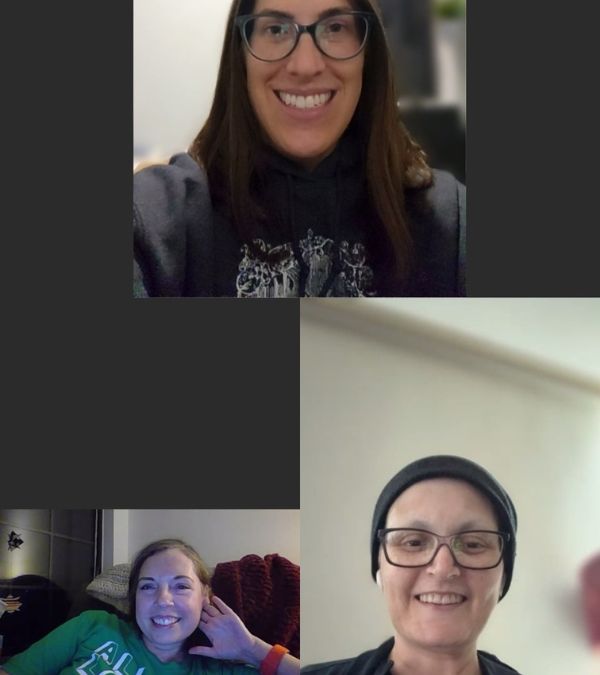
Over time, I made friendships with thrivers – people living fully with breast cancer – across the world, thanks to the power of social media. Carole and Krista became my “MBC besties.” We’ve talked nearly every week for almost 6 years. Our bond runs deeper than anything I’ve experienced with friends before. We laugh and cry together. We cope with morbid humor and make light of our epic failures. We share life and love from different time zones and from opposite sides of the world.
Guilt gut-check
Making friends from around the world, having a community that truly “gets it” – who wouldn’t want that? Well, it’s not so simple. All of these friends and acquaintances have also been diagnosed with terminal cancer. Getting to know people in this community can mean that you are signing up to process frequent deaths and to be faced with your own mortality. As you form bonds, you also open yourself to grief.
Some friendships in this community are forged quickly. You “meet” someone online and are soon sharing your most intimate thoughts. Since many of us become what I call “professional patients,” meaning it becomes a job to have cancer and adapt to all it entails, we have the time and space to form deep connections. The bond gets closer and closer, until a beautiful life is lost, sometimes with little warning.
Cue the lost feeling, the emptiness — and the guilt.
I’ve lost so many friends and acquaintances. And with each loss, guilt creeps in. I feel it when someone dies younger than I was when first diagnosed. I feel it when an admired community member passes and I wonder, “Why am I still here?” I feel it when others are on tough IV chemo, and I’m on “easy” targeted therapy instead, or when my disease is stable while someone else’s is progressing.
Sometimes the guilt is subtle: a quiet discomfort that I’m still thriving while others are not. Among my MBC besties, I currently have the best prognosis and that comes with a heavy weight of conflicted feelings. But when I shared these feelings with them, I received the most comforting response: “Don’t feel guilty. We are not struggling because you are thriving. That’s not how it works.”
So that is what I try to remember whenever I feel guilt, shame, awkwardness, and self-doubt.